What Caused the Shift in Jazz From Popular to Art Music
Jazz seems to be experiencing a bit of a renaissance amongst pic directors – await no further than documentaries such as "Miles Davis: Nativity of the Cool," which only premiered at the Sundance Film Festival, biopics such every bit "Born to Be Blue," and recent Oscar winners like "Whiplash."
While films virtually jazz are everywhere, evidence suggests that fewer people are actually consuming the music, putting the genre more than on par with classical music than with today'southward pop artists.
At that place are a host of reasons for the decline of jazz as a pop music, but the i that interests me as a music historian is the function that academics played.
In our attempt to elevate jazz to the ivory tower, nosotros may have inadvertently helped to kill it every bit a popular style.
However, all is non lost. While the genre might seem destined for academic obscurity, jazz continues to kick around in popular music – just in subtler ways.
Jazz captivates the land
In the 1920s, during the early years of the Slap-up Migration, waves of black Americans migrated from the South into the industrial cities of the North. Black jazz musicians, particularly those from New Orleans, brought their audio with them. They moved to neighborhoods such as The Stroll in Chicago, Black Bottom in Detroit, twelfth Street and Vine in Kansas City and, of course, Harlem. This occurred just as the record industry blossomed and radios became mainstays in American homes.
Jazz was well-positioned to get the most popular genre of music in the nation.
Over the next decade, the genre underwent a transformation. Artists began to amass larger ensembles, fusing the free energy of jazz with the volume of dance bands. The Swing Era was born, and jazz orchestras dominated pop charts.
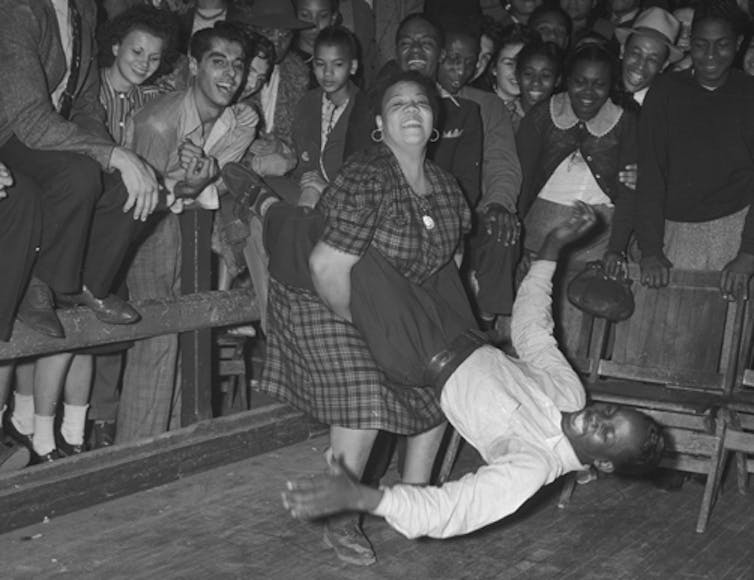
These developments led to a new set of issues. Larger bands meant less liberty to improvise, the cornerstone of jazz. During the 1940s, music recordings became increasingly important, and jazz musicians found themselves frustrated with how piffling they were being paid, resulting in a serial of strikes by the American Federation of Musicians.
By the fourth dimension these problems were resolved, America'south youth had already begun gravitating toward new styles of R&B and country, which would eventually morph into rock 'n' roll:
After that, jazz never really recovered.
From the club to the classroom
Jazz underwent another, more subtle, shift during that same time period: It left the club and went to higher.
Later World War 2, jazz genres fractured and the music became more circuitous. It as well became popular amid higher students. Dave Brubeck Quartet released several albums in the early 1950s that acknowledged the grouping's popularity with the college oversupply, including "Jazz at Oberlin" and "Jazz at the College of the Pacific."
Perhaps university administrators wanted to elevate a distinctly American genre to a status of "high art." Or, perchance they just wanted to capitalize on jazz'due south popularity among college students. Either mode, universities started to create curriculums geared towards the genre, and past the end of the 1950s, several institutions, such as the University of North Texas and the Berklee College of Music, had jazz programs upward and running.
In the classroom, jazz was explored in a new way. Rather than hearing jazz played while grinding on a dance flooring, it became something to dissect. In 1 of the earliest jazz histories, "The Story of Jazz," musicologist Marshall Stearns captures this shift. He begins his book by explaining how difficult information technology is to categorize the spirit of jazz. He then spends over 300 pages trying to practice just that.
Pop culture began to reflect jazz'southward shifting identity as the music of educated people. The 1953 film "The Wild One" features a billowy large band soundtrack that underscores the shenanigans of a motorcycle gang led by Marlon Brando.
Just two years later, "Blackboard Jungle," also features delinquent kids – except this time, they prefer the sound of Pecker Haley. In one scene, their math teacher tries to get the kids to appreciate his collection of jazz records. The scene ends with the kids beating the instructor and breaking his records.
Jazz had gone from the music of youthful rebellion to that of the cultured elite.
During the 1960s, jazz may accept been as eclectic as ever. Merely academics like historian Neil Leonard continued to push for jazz to be made into a serious subject of academic inquiry, as he argued in his volume "Jazz and the White Americans." Professional person groups devoted to the written report of jazz education were founded, such every bit the National Association for Jazz Teaching.
During the 1970s and 1980s, introductory jazz courses started to reach critical mass and led to the growth of what jazz critic Nate Chinen dubbed the "jazz-educational activity industry." Playing jazz required a college degree. Jazz had become the music of the educated. It was the music of Cliff and Clair Huxtable, one a doctor and the other a lawyer, from "The Cosby Show."
Only don't phone call it 'jazz'
In the final twenty years, jazz's identity as an bookish art form has but grown. At my establishment, about all of the not-classical class offerings in the music school are about jazz.
Today, in any given semester on whatever given campus, you can find college students sitting in classrooms at 9 a.m. on a Tuesday trying to blot the importance and complexity of a music meant to be heard in a club at 2 a.thousand. on a Sabbatum. It'southward go brussels sprouts for budding music aficionados: You know information technology'due south healthy, simply it doesn't necessarily sense of taste all that great.
Exterior of the classroom, a dwindling audience base has forced traditional jazz venues to play into the notion of jazz as an educated person's music. The current iteration of Minton's Playhouse, a lodge that was once a bastion of jazz energy, at present calls jazz "America's classical music" in an endeavor to raise the profile of the genre (and mayhap justify the toll of the steaks being served there).
Other venues have minimized jazz. This twelvemonth's New Orleans Jazz and Heritage Festival will characteristic decidedly non-jazz artists such equally Katy Perry, The Rolling Stones and Chris Stapleton.
Despite jazz'due south altitude from its pop roots, a little digging shows that nosotros nonetheless like listening to jazz more than than we retrieve. Nosotros just stopped openly calling it jazz.
Kendrick Lamar'due south 2015 anthology "To Pimp a Butterfly" is every bit as much a jazz anthology equally it is a rap album, thanks to Lamar's collaboration with the saxophonist Kamasi Washington. Washington also had a brusque picture, "As Told to Thou/D Thyself," based on his anthology, "Sky and Earth," at Sundance.
Lamar'southward album was such a revelation that information technology inspired David Bowie to feature a jazz ensemble as his backing band for his final stone album, "Blackstar."
Meanwhile, the music collective Snarky Puppy has get an international awareness by creating long-form jazz works while avoiding whatever specific labels. Another music collective, Scott Bradlee'southward Postmodern Jukebox, has establish a way to continue the sound of jazz live – and to embrace jazz's lighter side – past transforming contemporary pop songs into historical jazz genres.
With academia positioning jazz every bit art music, the genre is unlikely to experience a popular resurgence any time presently.
But today'southward artists are proving that the spirit of jazz is alive and well, and that jazz is much more than its name.
Peradventure this is plumbing equipment: The earliest jazz musicians didn't call their music "jazz" either. Instead, they blended their sound with pre-existing pop genres, and, in doing and so, created one of the most distinct forms of music in American history.
blankenshipbouricipt.blogspot.com
Source: https://theconversation.com/did-academia-kill-jazz-110485
0 Response to "What Caused the Shift in Jazz From Popular to Art Music"
Post a Comment